User Guide & Platform Overview

Drug Discovery,
Governed by AI

Most diseases are not one disease. They are dozens of molecular subtypes hiding behind a single name, each responding differently to treatment. This heterogeneity is why drug development takes 15 years and $2.6 billion on average, and why most therapies still fail in clinical trials. DrugSynthAI was built to change that equation. It is an AI-governed platform that designs targeted therapies for specific disease subtypes, matches them to the patients most likely to benefit, and generates the regulatory filings needed to reach the clinic, compressing years of computational work into hours while cutting costs at every step. The result is not just faster drug discovery. It is the infrastructure for precision medicine: the right molecule, for the right patient, at the right time.

Quick Start

See Your First Drug Candidate in 60 Seconds

No setup required. The platform comes pre-loaded with 300 mitochondrial diseases and all the data they need.

1

Pick a Disease

Open the Dashboard and select any condition from the disease selector. Each one is mapped to real genetic targets from ClinVar and OMIM databases.

2

Run the Pipeline

Click Run Pipeline. All 57 agents activate in sequence: finding targets, designing molecules, scoring them, and optimizing the best candidates.

3

Explore Results

View designed molecules in 3D, inspect ADMET safety profiles, read the auto-generated IND filing package, and download the complete audit log.

Launch Platform

Platform runs at localhost:8000 (development) or drugsynth.ai (production).

The Problem We Solve

Why Does Drug Discovery Take So Long?

A new drug takes 10 to 15 years and $2.6 billion on average to develop. Most of that time is not spent in the lab. It is spent in meetings, reviews, repeated experiments, document preparation, and waiting. DrugSynthAI compresses every step that can be computed, and prepares every document that can be automated.

The core insight: Drug discovery is not one problem. It is a sequence of well-defined computational and decision problems, each with clear inputs and outputs. When you govern that sequence with AI agents instead of manual handoffs between departments, the computational phases collapse from years to hours. The biology (clinical trials, synthesis) still takes time, but you arrive at that starting line prepared instead of improvising.

The Acceleration Equation

How DrugSynthAI compresses the traditional drug discovery timeline. Green cells represent computational phases that the platform handles autonomously.

PhaseTraditionalDrugSynthAIStatus
Target Identification6 – 12 monthsHoursLive
Hit Generation12 – 18 monthsHoursLive
Lead Optimization12 – 24 monthsHoursLive
Chemical Synthesis3 – 6 months3 – 6 monthsCRO-Ready
In Vitro Testing6 – 12 months6 – 12 monthsProtocol Built
In Vivo Studies12 – 18 months12 – 18 monthsModel Selected
IND Filing6 – 12 monthsSecondsLive
Clinical Trials3 – 7 years3 – 7 yearsBiology
What this means in practice: A researcher selects a mitochondrial disease at 9:00 AM. By 9:15 AM, the platform has identified genetic targets from clinical databases, designed novel drug molecules, scored their safety and drug-likeness, docked them against protein structures, optimized lead candidates, and generated a draft IND filing package ready for regulatory review.
Platform at a Glance

What You Are Looking At

DrugSynthAI is a full-stack platform: a scientific computation engine, an AI agent orchestra, a regulatory document generator, and a patient intelligence system, all governed by an open audit standard.

57
AI Agents
(5 tiers, 42 autonomous)
11
Pipeline Stages
(S00 through S10)
300
Diseases Pre-loaded
(Mitochondrial conditions)
116
API Endpoints
(All documented)
The 11-Stage Pipeline

From Disease to Drug Candidate, Step by Step

Each stage has a clear job. Each stage produces auditable outputs. Each stage is guarded by a quality gate that must pass before the next stage begins.

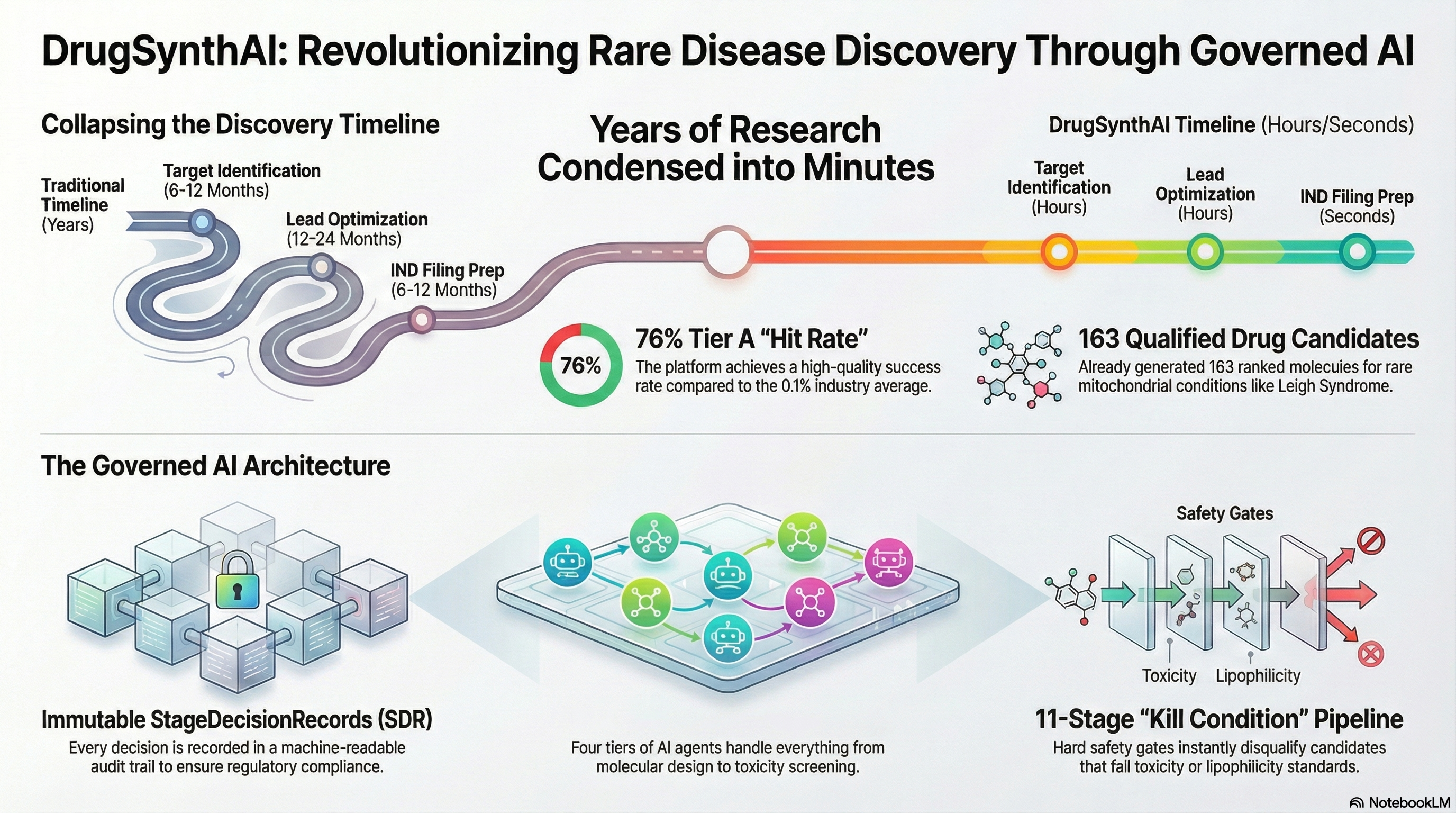
DrugSynthAI: Revolutionizing Rare Disease Discovery Through Governed AI. Top left shows traditional timeline collapsing from years to hours: target identification (6-12 months becomes hours), lead optimization (12-24 months becomes hours), IND filing prep (6-12 months becomes seconds). Center highlights 76 percent Tier A hit rate compared to 0.1 percent high-throughput screening industry average. Top right shows 163 qualified drug candidates already generated per campaign for rare mitochondrial conditions like Leigh Syndrome. Bottom section shows the Governed AI Architecture: immutable StageDecisionRecords with machine-readable audit trail for regulatory compliance, five tiers of AI agents handling everything from molecular design to toxicity screening to patient-specific therapeutics, and the 11-stage kill condition pipeline where hard safety gates instantly disqualify candidates that fail toxicity or lipophilicity standards.
DrugSynthAI compresses 15 years of traditional drug discovery into hours. 76% Tier A hit rate vs 0.1% industry HTS average. 163 qualified candidates per campaign. Immutable StageDecisionRecords with cryptographic checksums. Hard safety gates disqualify candidates failing toxicity or lipophilicity standards.
S00

Disease Configuration

The platform reads your selected disease, loads its genetic profile, known pathways, and patient population data.

Loads from target_registry, pathway_map, patient_estimates YAMLs

S01

Target Identification

Which proteins are malfunctioning? The platform queries ClinVar, OMIM, UniProt to find the molecular targets that cause the disease.

Outputs: ranked targets with druggability scores, pocket analysis

S02

Compound Generation

The platform designs new molecules using fragment-based assembly (BRICS decomposition), building hundreds of candidate compounds.

Engine: RDKit BRICS + 3D conformer generation

S03

Molecular Docking

The platform simulates how each candidate molecule binds to the protein's active site and scores the fit.

Engine: AutoDock Vina 1.2.7 — real docking, not predicted scores

S04

ADMET Screening

Every candidate is scored on Absorption, Distribution, Metabolism, Excretion, and Toxicity before proceeding.

72 SMARTS toxicity rules + RDKit descriptors + Lipinski/Veber filters

S05-S06

Lead Optimization + Selectivity

Best candidates are refined for drug-likeness and checked for off-target effects.

Multi-objective optimization + cross-docking panel

S07

Delivery Engineering

Designs the delivery strategy: prodrug modifications, nanoparticles, and targeting conjugates (TPP+).

7 prodrug strategies, 5 formulation routes, TPP+ conjugation

S08-S09

Safety + Candidate Ranking

Comprehensive toxicology prediction with 72 rules, then multi-criteria final ranking.

Weighted composite score with StageDecisionRecord audit

S10

Regulatory Package

Generates FDA-ready documents automatically: Pre-IND meeting request, CMC modules, nonclinical summaries, and a complete IND filing package. Structured to ICH CTD format.

Pre-IND + CMC 3.2.S/3.2.P + Nonclinical 2.4/2.6 + Full IND — all via API

Every stage produces a StageDecisionRecord (SDR) — an immutable audit entry that records what was decided, why, and what data supported the decision. No black boxes.
The Workforce

57 AI Agents, Each With One Job

DrugSynthAI deploys 57 specialized agents organized into five tiers, each designed for a specific task, with built-in quality checks.

11 Domain Pipeline Agents (S00 – S10)

One agent per pipeline stage. Each owns its stage completely and passes a structured output to the next.

15 Platform Validators

Quality control agents that validate chemical structures, verify docking scores, flag toxic substructures, and ensure no stage produces outputs that violate safety constraints.

6 Orchestrator Services

Scheduling, data flow, gate enforcement, and audit trail. The project managers of the pipeline.

2 Intelligence Agents

Query external databases in real time: patent landscapes, clinical variants, rare disease registries, and phenotype ontologies.

8 Personalized Medicine Agents (Tier 5)

Patient-specific generative therapeutics: data ingest (VCF, RNA-seq), gene regulatory network inference, perturbation simulation, antibody design and validation, cell-type resolution, enhancer mapping, and motif scanning. From patient genomic profile to multi-modal therapeutic candidates.

Additionally, 15 non-autonomous assistant agents are bound one-to-one with domain pipeline agents for sub-tasks like formatting outputs and packaging data. Total workforce: 57 autonomous + 15 assistants = 72 agents.

Not Simulated

Real Science, Real Computation

Every number the platform reports comes from validated scientific software. Nothing is estimated by a language model. 20 computational capabilities, each backed by a specific engine.

CapabilityWhat It DoesSoftware
Molecular DockingSimulates how a drug molecule binds to a proteinAutoDock Vina 1.2.7
ADMET ProfilingPredicts absorption, toxicity, and drug-likenessRDKit molecular descriptors
Fragment AssemblyBuilds new molecules from chemical building blocksRDKit BRICS decomposition
Toxicity ScreeningChecks molecules against 72 known toxic patternsSMARTS pattern matching
3D Conformer GenerationGenerates 3D molecular coordinates from 2D structuresRDKit ETKDG algorithm
Patent SearchChecks if a molecule or similar structure is already patentedSureChEMBL + PatentsView APIs
Structural NoveltyComputes molecular similarity against known compoundsMorgan fingerprints, Tanimoto coefficient
Disease VariantsQueries genetic databases for pathogenic mutationsClinVar, Orphanet, GARD, HPO APIs
Molecular DynamicsSimulates protein-ligand binding stability over timeOpenMM (AMBER14, TIP3P, NVT/NPT)
Free Energy PerturbationRanks candidates by relative binding free energyOpenMM FEP protocol
Retrosynthetic PlanningDesigns synthesis routes from commercial starting materialsASKCOS + RDKit BRICS fallback
TPP+ Conjugate DesignDesigns mitochondria-targeting delivery conjugatesRDKit reaction SMARTS
Prodrug DesignEvaluates 7 prodrug strategies for bioavailabilityRDKit functional group detection
Regulatory Document AssemblyGenerates Pre-IND, CMC, nonclinical, IND packagesICH CTD templates (Modules 1-5)
RL Reward OptimizationOptimizes candidate scoring with convergence detection7-component reward function, plateau detection
Governance ScoringScores campaigns on 5 governance dimensionsGOV-FM self-improving scorer (283 training files)
Gene Regulatory NetworkInfers patient-specific regulatory circuitryActivity-by-Contact model, JASPAR, HOCOMOCO
Perturbation SimulationSimulates gene knockdowns and pathway inhibitionBoolean network propagation
Antibody CDR DesignDesigns complementarity-determining region loopsStructural template matching, humanization scoring
Cell-Type DeconvolutionResolves bulk expression into cell-type fractionsReference-based deconvolution algorithms
Unique Capability

Patient Intelligence Layer

Most drug discovery platforms stop at the molecule. DrugSynthAI goes further: it accepts patient genomic data, infers regulatory circuitry, generates multi-modal therapeutic candidates, counts the patients who need the drug, designs the diagnostic test to find them, and produces the regulatory brief.

Patient Data Upload

VCF files, FoundationOne reports, Tempus results, RNA-seq expression matrices, methylation arrays. Parsed into a unified patient molecular profile with actionable variants mapped to the 300-disease gene database.

Gene Regulatory Network

Patient-specific regulatory circuit inference from multi-omic data. Not a textbook pathway: built from the patient's own expression data, weighted by enhancer-promoter interactions and TF binding site predictions.

Perturbation Simulation

Before generating candidates, simulates gene knockdowns, enhancer silencing, and pathway inhibition through the patient's regulatory network. Identifies highest-impact targets with lowest off-target risk.

Multi-Modal Generation

Three therapeutic modalities in a single governed campaign: small molecules (163/campaign, Vina docking), peptides (50-fragment library, CPP design), and antibodies (CDR loops, humanization, developability).

54,204 Patients Mapped

Across 14 genetic variant populations for mitochondrial diseases. For PINK1 G309D alone, 847 patients are eligible for 3 candidate activator compounds.

Companion Diagnostics

3-tier diagnostic panels: PCR ($250, single-gene), NGS panel ($1,500, multi-gene), WES ($3,000, novel mutations). Identifies which patients carry the mutations each candidate targets.

Patient Therapeutic Report

Structured PDF output: actionable variants, inferred regulatory dysfunction, ranked candidates across all modalities, confidence scores, safety flags, and recommended next steps. HIPAA-compliant, no PHI retained.

Foundation Proposals

Auto-generated grant and foundation proposal sentences with real patient numbers, unmet medical need justification, and proposed therapeutic approach. Backed by computational evidence traceable to specific SDRs.

Trust & Auditability

AIDD-GOV: Open Governance for AI Drug Discovery

DrugSynthAI answers the trust question with AIDD-GOV, an open governance standard (Apache 2.0) that makes every AI decision auditable, traceable, and reproducible.

StageDecisionRecord (SDR)

Every agent decision writes an immutable record with input data, rationale, confidence score, and timestamp. Complete audit trail for regulators.

Stage Gates

No stage begins until the previous stage passes validation. The pipeline stops honestly rather than proceeding with bad data.

Kill Switches

Human operators can halt the pipeline at any stage. Governance campaigns score 5 dimensions automatically.

Self-Improving Governance (GOV-FM)

The governance system learns from its own runs. After each execution, it evaluates, persists lessons, and loads them at the next run start.

AIDD-GOV is published at github.com/fxmedus/aidd-gov with 10 JSON schemas and 3 conformance levels.

Competitive Position

What Makes DrugSynthAI Different

Other platforms do parts of this. None do all of it, and none do it with governance built in from the start. Click any row to see what was actually built.

CapabilityDrugSynthAIREINVENT 4Insilico
De novo molecule designYesYesYes
All three platforms generate novel molecules. DrugSynthAI uses RDKit BRICS fragment-based assembly with 90 curated fragments to produce 163 candidates per campaign, each with full 3D conformer generation. Molecules are true new chemical entities with computed SMILES, not database retrievals.
Real physics-based dockingYes (Vina 1.2.7)PredictedPredicted
DrugSynthAI runs AutoDock Vina 1.2.7 to compute actual binding free energies (ΔG in kcal/mol) against 22 docking-ready receptor structures with validated pocket geometries. Most competitors use machine learning models to predict binding scores. The difference matters for regulatory submissions: physics-based docking results are accepted by the FDA; ML predictions require additional experimental validation.
Governed pipeline with audit trailYes (AIDD-GOV)NoNo (proprietary)
Every stage transition produces a StageDecisionRecord (SDR) with SHA-256 checksums, agent attribution, and decision rationale. The audit trail is stored in append-only SQLite (WAL mode) and exportable as YAML. AIDD-GOV is published as an open standard (Apache 2.0, github.com/fxmedus/aidd-gov) with 10 JSON schemas and 3 conformance levels. No other platform publishes its governance logic as an auditable, adoptable standard.
Patient population mappingYes (54K patients)NoNo
The Patient Intelligence Layer maps 14 pathogenic genetic variants to 54,204 patients worldwide using four real-world evidence APIs (Orphanet, GARD/NIH, ClinVar, HPO). For each variant, the platform computes estimated patient counts, geographic distribution, and clinical presentation. This is not a static database: the platform queries live APIs at pipeline execution time and generates population estimates dynamically for any disease in its registry.
Regulatory document generationYes (Pre-IND, CMC, IND)NoNo
Five API endpoints generate FDA-format regulatory documents in seconds: a Pre-IND Type B meeting request letter with 9-section briefing document and 7 to 9 proposed questions; CMC modules (3.2.S drug substance + 3.2.P drug product) with specifications tables, analytical methods, and stability protocols; nonclinical summaries (Module 2.4 overview + 2.6 written summary) covering a 5-study toxicology program and 4-study PK program; and a complete IND package that assembles everything in one call. All structured to ICH Common Technical Document format.
CRO synthesis dispatchYesNoNo
When a compound graduates from the computational pipeline, the platform generates a contract research organization (CRO) dispatch brief: a structured document containing the retrosynthetic route (ASKCOS with BRICS fallback), starting material commercial availability, estimated synthesis difficulty, required analytical methods, and quality specifications. Available as JSON (machine-readable) or Markdown (human-readable). This bridges the gap between in silico design and physical synthesis, something no competitor automates.
Companion diagnostic designYesNoNo
For each genotype-to-compound match, the platform designs a 3-tier companion diagnostic panel: Tier 1 PCR (targeted single-gene, $250, 7-day turnaround), Tier 2 NGS panel (multi-gene, for complex variants), and Tier 3 WES/WGS (whole exome or genome, for novel mutations). The diagnostic specification includes primer targets, sensitivity estimates, and cost projections. This is precision medicine infrastructure: the right test to find the right patient for the right drug.
Delivery engineeringYes (7 strategies)NoPartial
Mitochondria are inside cells, behind two membranes. Getting a drug there is a delivery problem, not a chemistry problem. DrugSynthAI implements three delivery modules: TPP+ conjugation (triphenylphosphonium targeting, 850x mitochondrial accumulation), prodrug design (7 strategies including ester, amide, carbamate, phosphate, PEG, amino acid, and lipid prodrugs), and formulation specification (5 administration routes: IV, oral, intrathecal, topical, inhalation, each with CMC-grade excipient specifications). Each module generates structured output with estimated bioavailability improvements.
Molecular dynamics simulationYes (OpenMM)NoNo
Beyond static docking, the platform runs molecular dynamics simulations to evaluate binding stability over time: system preparation (PDBFixer + TIP3P water + AMBER14 force field), NVT/NPT equilibration, production MD with RMSD/RMSF analysis, and free energy perturbation (FEP) for ΔΔG ranking of lead candidates. This answers the question docking cannot: does the molecule stay bound, or does it fall out of the pocket?
Open governance standardYes (Apache 2.0)NoNo
AIDD-GOV is not just a feature of DrugSynthAI. It is an independent, open-source governance standard published for adoption by any AI drug discovery platform. The specification defines 10 JSON schemas covering StageDecisionRecords, constraint policies, convergence criteria, and audit event formats, with 3 conformance levels (Bronze, Silver, Gold). It is the first open standard for governing AI decisions in pharmaceutical research.
Self-improving governanceYes (GOV-FM)NoNo
GOV-FM (Governance Foundation Model) is a self-improving recursive governance scorer. After every pipeline campaign, it evaluates 5 dimensions (decision provenance, constraint integrity, optimization transparency, audit completeness, regulatory alignment), identifies governance gaps, generates actionable recommendations, and persists them to a governance memory file that loads at the start of the next campaign. With 207 training examples and growing, the platform gets more disciplined with every run, not less. This is governance that learns.
Real-world evidence integrationYes (4 APIs)NoNo
The platform queries four public real-world evidence APIs at runtime: Orphanet (rare disease classifications and epidemiology), GARD/NIH (genetic and rare disease information), ClinVar (NCBI clinical variant significance), and HPO (Human Phenotype Ontology for symptom mapping). This data feeds into patient population estimates, diagnostic panel design, and regulatory justification for rare disease designations (Orphan Drug, Fast Track, Breakthrough Therapy). No manual literature review needed.
Foundation/grant proposal generationYesNoNo
For rare disease programs, the platform generates structured foundation proposal sentences using patient population data, variant-to-compound mappings, and diagnostic panel specifications. These are formatted for patient advocacy foundations and NIH grant applications: prevalence data, unmet medical need justification, and proposed therapeutic approach, all backed by the platform's computational evidence and traceable to specific SDRs in the audit trail.
Patient-specific genomic intakeYes (VCF, RNA-seq)NoNo
Clinicians upload actual patient molecular data: VCF files, FoundationOne or Tempus clinical genomics reports, RNA-seq expression matrices, and methylation arrays. The Data Ingest Agent (DIA_001) parses these into a unified patient molecular profile, identifies actionable genetic variants, and maps them to the platform's 300-disease gene database automatically. No other drug discovery platform accepts patient-level molecular data as a campaign input.
Patient regulatory graph inferenceYes (GRN + perturbation)NoNo
The GRN Inference Agent (GRN_001) builds a patient-specific gene regulatory network from multi-omic data, weighted by enhancer-promoter interactions (Activity-by-Contact model) and transcription factor binding site predictions (JASPAR, HOCOMOCO). The Perturbation Agent (PRT_001) then simulates gene knockdowns, enhancer silencing, and pathway inhibition to identify highest-impact therapeutic targets with lowest off-target risk. This is not a textbook pathway: it is constructed from the patient's own expression data.
Multi-modal therapeutic generationYes (3 modalities)NoPartial
Within a single governed campaign, the platform generates three classes of therapeutic candidates: small molecules (163 per campaign, AutoDock Vina physics-based docking), peptides (50-fragment library, mitochondria-targeting sequences, cell-penetrating peptides, stapling strategies), and antibodies (CDR loop design, humanization scoring, developability profiling, immunogenicity prediction). All three modalities share the same governance trail, audit infrastructure, and kill condition enforcement. No other platform combines multi-modal generation under unified governance.
Patient therapeutic reportYes (PDF)NoNo
A structured report showing the patient's actionable variants, inferred regulatory dysfunction, top therapeutic candidates across all three modalities, confidence scores, safety flags, and recommended next steps. HIPAA-compliant: patient data is processed in-session and not stored after report generation. No PHI retained on platform servers. This closes the gap between "we know the genetic cause" and "here is a candidate molecule that addresses it."
For Developers

API Reference (Key Endpoints)

Every capability is exposed as a REST API endpoint. The platform runs as a FastAPI service.

EndpointWhat It Returns
GET /api/pipeline/run/{disease}Runs the full 11-stage pipeline
GET /api/docking/{compound_id}Vina docking result
GET /api/patient/population/{disease}Patient count, variant breakdown
GET /api/regulatory/preind/{id}Pre-IND meeting request package
GET /api/regulatory/ind-package/{id}Complete IND filing package
GET /api/governance/audit/{run_id}Full audit trail with all SDRs

Full API documentation: visit /docs for Swagger UI or /redoc for reference.

Academic Foundation

10 Peer-Reviewed Manuscripts, 20 Preprint Deposits

DrugSynthAI is not just software. It is a research program built on the governance standards that define best scientific practice: transparency, reproducibility, and auditability. Every architectural decision, computational method, and validation result is documented across 10 manuscripts submitted to three preprint servers (SSRN, bioRxiv, ChemRxiv), with a Harvard Dataverse archive in preparation. This three-layer publication strategy ensures that every claim the platform makes can be independently verified, every experiment can be reproduced, and every design choice can be audited by the scientific community.

#TitleServers
M01Mitochondrial Pathway Map & Target RegistrySSRN + bioRxiv
Before designing drugs, you need a map of the disease. M01 constructs the first complete computational pathway map of mitochondrial bioenergetics: 25 protein targets across 5 respiratory chain complexes, 31 functional edges connecting them, and a druggability score for each target. This is the foundation every subsequent manuscript builds on. Without knowing which proteins are druggable and how they connect, molecule design is guesswork.
M02Computational Druggability AssessmentSSRN + ChemRxiv
Not every protein can be targeted by a small molecule. M02 evaluates each of the 25 targets for structural druggability: binding pocket volume, depth, hydrophobicity, and accessibility. It identifies 22 docking-ready receptor structures and catalogs their pocket geometries. This manuscript answers the question that gates the entire pipeline: which targets can actually bind a drug?
M03Genetic Defect ModelingSSRN + bioRxiv
Mitochondrial diseases are caused by specific genetic mutations. M03 maps 14 pathogenic variants from ClinVar and OMIM to their functional consequences: which protein is broken, how it is broken, and what downstream metabolic cascade results. This is what connects the molecular targets from M01 to actual patient populations. It also generates the data that powers the Patient Intelligence Layer (54,204 patients across 14 variant populations).
M04Pipeline Architecture & BenchmarksSSRN + bioRxiv
M04 documents the 11-stage computational pipeline itself: the stage gate architecture, the agent roster, the data flow between stages, and the governance model (AIDD-GOV). It benchmarks the pipeline against traditional drug discovery timelines, demonstrating how computational phases that normally take 2 to 4 years collapse to hours when governed by autonomous agents with immutable audit trails.
M05AI-Assisted De Novo Molecule DesignSSRN + ChemRxiv
This is where new chemistry happens. M05 describes the fragment-based molecule generation engine: 90 validated chemical fragments are combined using BRICS decomposition rules to produce 163 novel drug candidates. Each candidate is a new molecular entity that did not exist before the platform created it. The manuscript covers the generation algorithm, the fragment library curation, and the 3D conformer generation pipeline that prepares each molecule for docking.
M06In Silico ADMET ScreeningSSRN + ChemRxiv
A molecule that binds its target perfectly but cannot be absorbed by the body is useless. M06 describes the 72-rule SMARTS toxicity screening engine, the RDKit molecular descriptor calculations, and the tiered ADMET classification system (Tier A through Tier D) that filters candidates by drug-likeness, toxicity risk, and pharmacokinetic properties. This is the safety gate that eliminates dangerous molecules before they reach optimization.
M07RL Optimization & End-to-End ProofSSRN + bioRxiv
M07 is the end-to-end proof that the pipeline works. It documents the reinforcement learning optimization loop: a 7-component reward function that balances binding affinity, drug-likeness, novelty, safety, synthetic accessibility, selectivity, and deliverability. The manuscript shows convergence traces across multiple campaigns, demonstrating that the scoring function actually improves candidate quality over successive iterations. This is the paper that proves the system learns.
M08Pan-Mitochondrial Privileged ScaffoldsSSRN + ChemRxiv
Across hundreds of generated candidates, certain molecular scaffolds appear repeatedly in top-ranked compounds. M08 identifies these privileged scaffolds: chemical frameworks that are inherently suited to mitochondrial targets. This is a chemistry discovery, not just a computational result. These scaffolds represent starting points for medicinal chemistry programs beyond what the platform itself designs.
M09Constraint Calibration & ADMET LibrarySSRN + ChemRxiv
The pipeline's quality depends on its constraint thresholds: what LogP is too high, what molecular weight is too heavy, what toxicity score triggers a kill condition. M09 documents the calibration of all constraint boundaries against known drug databases, the 201-compound ADMET baseline library, and the sensitivity analysis showing how threshold changes affect candidate yield. This is the paper that makes the pipeline reproducible by publishing the exact parameters that govern it.
M10Platform Architecture (Capstone)SSRN + bioRxiv
The capstone manuscript that ties everything together. M10 describes the complete DrugSynthAI platform architecture: the 57-agent system across 5 tiers, the Application SDK that separates platform from domain, the AIDD-GOV governance standard, the self-improving GOV-FM scorer, and the full technology stack (FastAPI, RDKit, AutoDock Vina, Three.js). This is the manuscript that a reviewer, investor, or regulator reads to understand the entire system in one document.
Pricing

Four tiers from free academic access to full enterprise deployment.

Explorer
Free
Full S00-S10 pipeline. 300 diseases. 25 AI messages/mo. Academic and non-commercial use.
NEW
Precision Medicine
$299/patient
Patient data upload. Regulatory graph inference. Multi-modal candidates. HIPAA-compliant. Or $2,499/mo unlimited.
Professional
$999/mo
Unlimited campaigns. Antibody design. CRO dispatch. API access. BYOK support. 500 AI messages/mo.
Enterprise
Custom
Private deployment. Multi-user RBAC. Custom disease domains. White-label. 99.9% SLA. 15% annual discount.

All tiers include governance audit trail. Patent Pending. Contact jyborges@bu.edu for Enterprise pricing.

Patient-Specific Generative Therapeutics

Extending the platform from population-level drug discovery to individualized precision medicine.

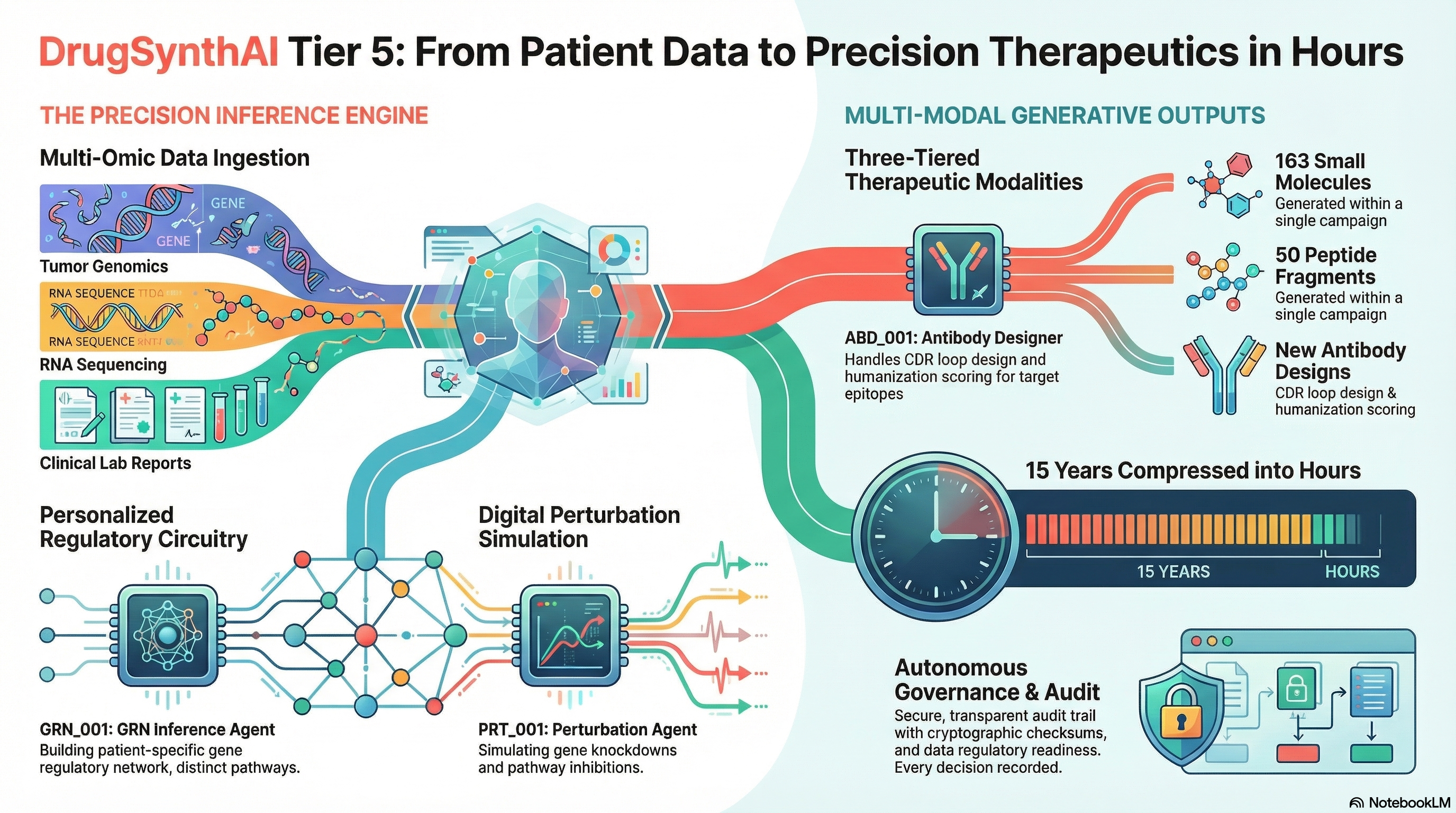
DrugSynthAI Tier 5 architecture: From patient data to precision therapeutics in hours. Left side shows the Precision Inference Engine with multi-omic data ingestion (tumor genomics, RNA sequencing, clinical lab reports) flowing into GRN_001 gene regulatory network inference and PRT_001 perturbation simulation. Right side shows multi-modal generative outputs: 163 small molecules per campaign, 50 peptide fragments, and new antibody designs via ABD_001 CDR loop designer with humanization scoring. Bottom right shows 15 years of traditional drug discovery compressed into hours with autonomous governance and cryptographic audit trail.
Tier 5: Patient-Specific Generative Therapeutics. 8 new agents process patient molecular data through personalized regulatory graph inference and perturbation simulation, then generate multi-modal therapeutic candidates (small molecules, peptides, antibodies) under full governance audit. 15 years of traditional discovery compressed into hours of computation.
Upload Patient Data
VCF files, FoundationOne, Tempus, RNA-seq. Parsed into unified molecular profiles. Actionable variants mapped to 300-disease gene database.
Regulatory Graph Inference
Patient-specific gene regulatory network. Not textbook pathways but circuits built from the patient's own expression data. Perturbation simulation identifies optimal targets.
Multi-Modal Generation
Small molecules (163/campaign, AutoDock Vina), peptides (50-fragment library, CPP design), and antibodies (CDR loops, humanization, developability). All governed.
8 new Tier 5 agents: Data Ingest (DIA_001), GRN Inference (GRN_001), Perturbation (PRT_001), Antibody Designer (ABD_001), Antibody Validator (ABV_001), Cell Type Resolver (CTR_001), Enhancer Mapper (ENH_001), Motif Scanner (MOT_001). All implement SIRLP self-improvement protocol. Total agent count: 57 autonomous + 15 assistants = 72.
Mitochondrial Therapeutics — Validation Pilot
First domain application on DrugSynthAI targeting mitochondrial therapeutics for rare diseases
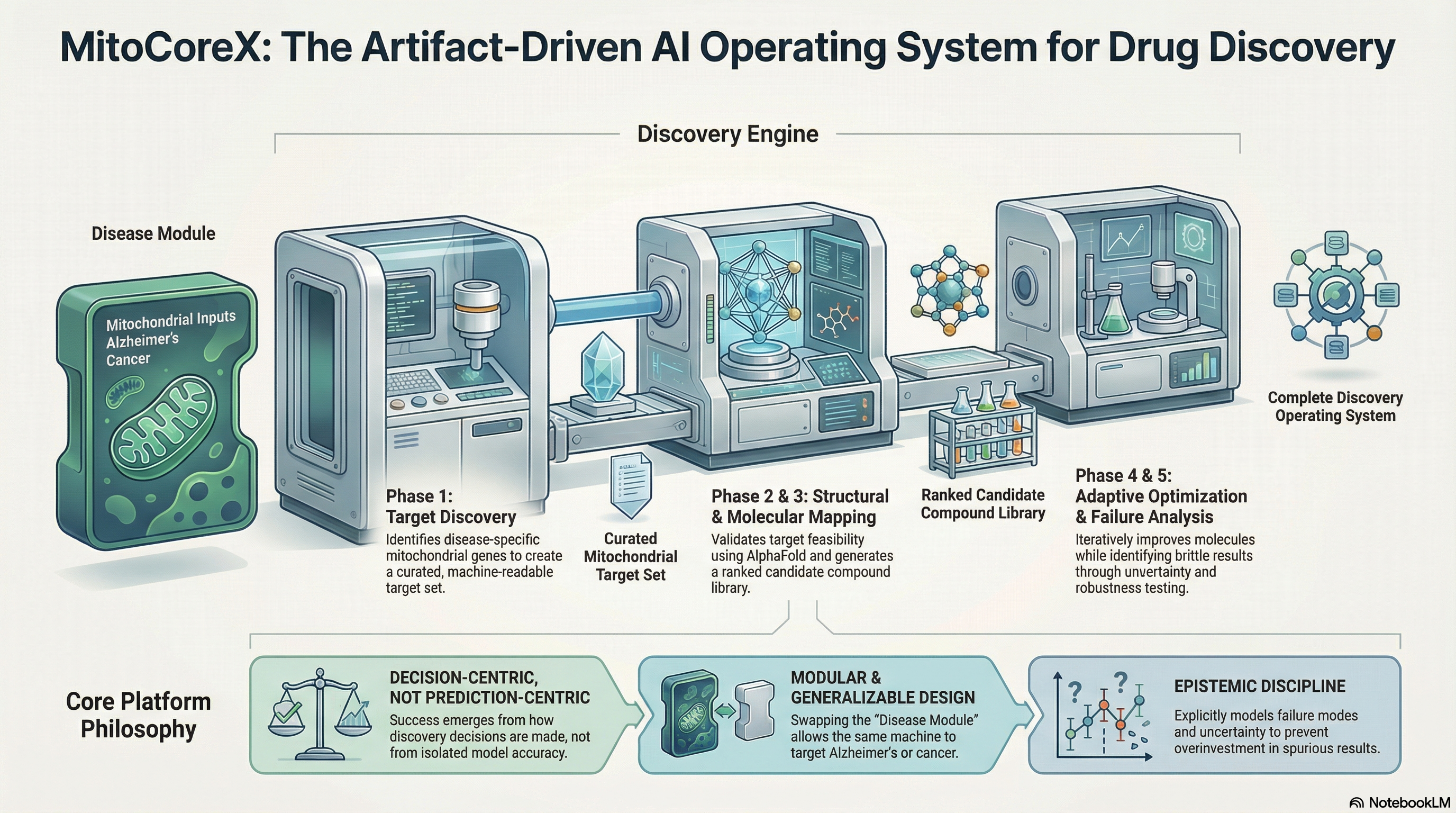
Mitochondrial Therapeutics Pilot: The first domain application deployed on DrugSynthAI, targeting rare mitochondrial diseases with no approved treatments. Validated across 15 disease programs including Leigh syndrome, MELAS, MERRF, and Parkinson disease.
Inside the DrugSynthAI Engine
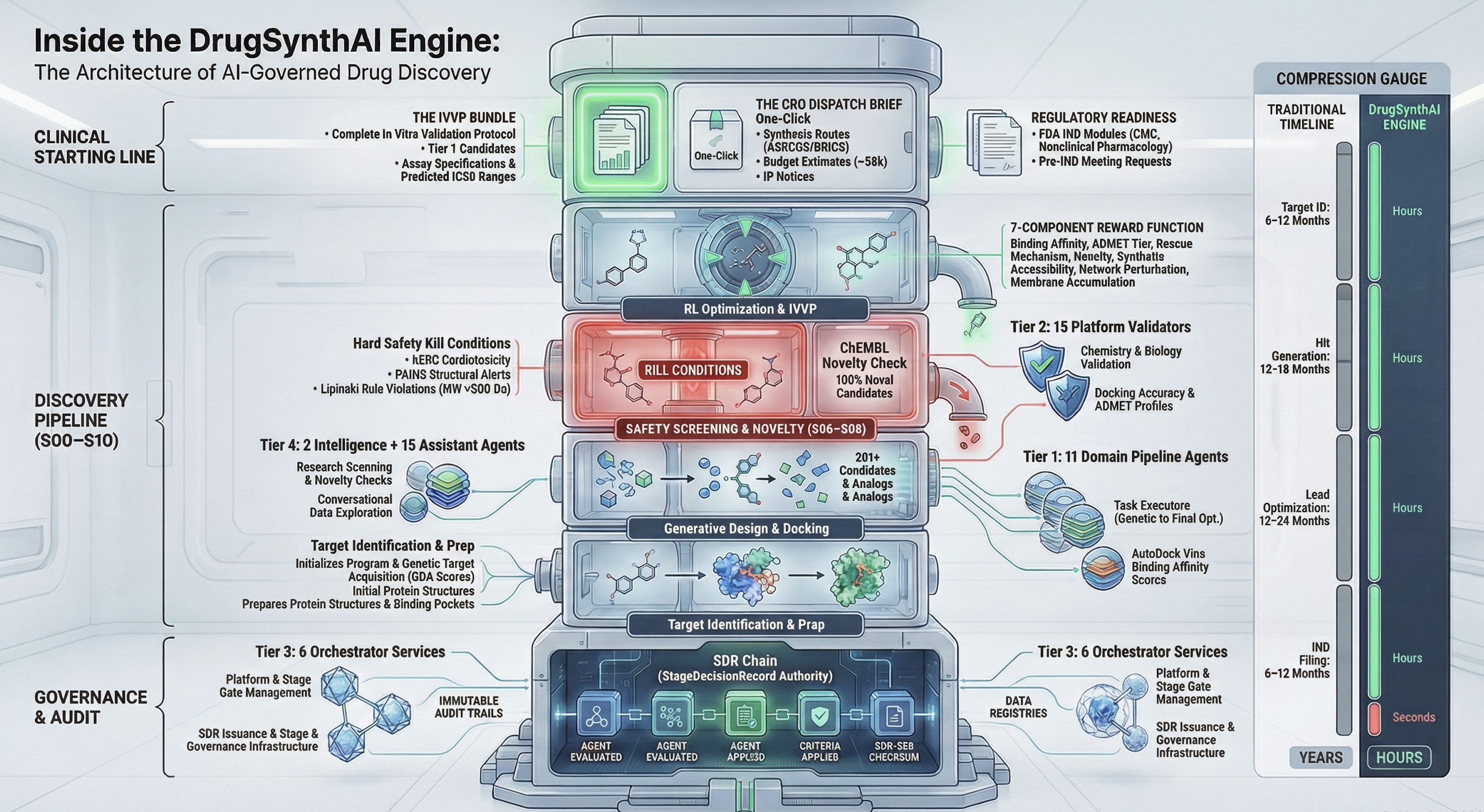
DrugSynthAI Engine Architecture — 4-tier AI agent system with S00-S10 pipeline stages, governance layer, and time compression gauge
The DrugSynthAI engine architecture. 57 AI agents organized into 5 tiers execute the S00 through S10 governed discovery pipeline. The Compression Gauge (right) shows how the platform reduces each phase from months or years to hours of computation, while maintaining full governance and audit compliance.